In an era dominated by competitive multiplayer experiences and solo adventures, Big Walk emerges as a breath of fresh air that fundamentally reimagines what cooperative gaming can achieve. Three years after its initial announcement, this Australian Outback-inspired title from House House—the studio behind the viral sensation Untitled Goose Game—has finally arrived, and it defies easy categorization. Having spent over 20 hours exploring its mysterious island with friends and family, one thing becomes abundantly clear: Big Walk represents something genuinely new in gaming, a co-op experience that strips the medium down to its essential elements and invites players of all skill levels to rebuild it together through shared discovery and invented language.
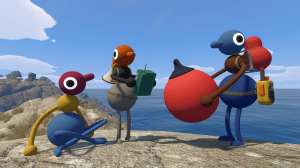
The game accommodates groups of 2-12 players who embody charmingly abstract characters—imagine multicolored snowmen with elongated noses and noodly appendages—as they traverse a vast, handcrafted island in search of nameless collectibles through an abundance of inventive puzzles. This intentionally minimalist premise conceals remarkable depth that reveals itself gradually over dozens of hours of exploration and experimentation. House House, founded in Melbourne in 2013, has demonstrated a remarkable ability to create games that feel both accessible and profound, and Big Walk represents their most ambitious project to date.
A Masterclass in Intuitive Design
Before venturing into the wild, players gather in a starting area reminiscent of a playground or children’s gymnasium, filled with buttons to press, vibrant bouncy objects to manipulate, and climbable surfaces. This space serves as an organic tutorial, teaching everything essential about the game’s mechanics—from the extensive gesture system and proximity-based voice chat to the physics that govern the world. Importantly, falling great distances won’t result in damage, though you might drop whatever you’re carrying into a forest where it could remain hidden until sunrise. The first four puzzles act as a structured introduction before the entire island opens up simultaneously, inviting players to chart their own unique course through the adventure.
Unlike procedurally generated experiences such as Peak, Big Walk’s island is entirely handcrafted, and this intentionality permeates every element of its design. Switchbacks down mountainsides offer tantalizing glimpses of distant landmarks, while scattered radio stations each play unique songs that players can carry with them on their journey. The density of puzzles means that elements from one challenge sometimes become crucial to solving others, with clever environmental hints guiding observant players toward these connections. This approach to world design reflects a philosophy that trusts players to discover solutions organically rather than following waypoints or reading tutorial prompts.
Scaling Challenge and Shared Language
The game intelligently adapts to different group sizes, with the host maintaining save data across sessions while different versions of the island exist for parties of two, three, or four-plus players. Each puzzle receives slight tweaks to accommodate varying player counts, ensuring appropriate challenge regardless of group composition. Some puzzles become easier with more minds working together, while others descend into delightful chaos—one early basketball-style puzzle involving bouncy lights can quickly become a comedy of errors as a dozen players inadvertently block each other’s attempts until someone establishes turn-taking order. This scalability represents a significant technical and design achievement that few cooperative games have attempted.
Perhaps Big Walk’s most remarkable quality is how it encourages groups to develop their own vocabulary and body language through play. The visual communication is crystal clear from the outset, but everything else emerges organically from shared experience. Playing with two children, the author’s family began calling the collectibles “eggy things” due to their shape, while their characters became “walklings.” As a hazy narrative unfolded, they interpreted it through their own invented terminology. This approach reflects House House’s deliberate choice to fill their world with fundamental gaming elements—puzzles and rewards—while adding nothing prescriptive beyond that foundation. There are no quest markers, on-screen prompts, or resource bars to manage. Every element exists within the game world itself, and every discovery belongs entirely to the players who make it.
Communication as Core Gameplay
The puzzle design demonstrates extraordinary variety while building on approximately six to eight core concepts that receive increasingly clever variations throughout the adventure. Some challenges require close collaboration with precisely timed actions, while others demand that players separate across great distances, making reunion into its own puzzle. Many scenarios deliberately inhibit communication—one memorable example places a player behind soundproof glass, forcing them to relay visual information to teammates who cannot directly observe what they’re seeing. In one particularly devious puzzle, a player must wear a blinding helmet while teammates guide them vocally through an obstacle course. Hours later, this same helmet returns with new rules requiring the wearer to transport specific objects to designated areas, meaning the team must first identify correct items before verbal guidance can even begin.
The proximity chat system proves essential to Big Walk’s magic, and using external voice communication like Discord would effectively circumvent the intentional friction built into many puzzles. This self-policing requirement represents the game’s primary caveat—players must choose to engage with the system as designed to experience its full potential. The comparison to playing horror games with lights on feels apt: possible, but fundamentally undermining the experience. When embraced fully, however, the proximity chat creates countless memorable moments of miscommunication, desperate shouting across distances, and triumphant reunions after extended separations.
An Unforgettable Journey to a Surprising Conclusion
Inventory management reinforces the cooperative philosophy, limiting players to items held in hands, on belts, or in backpacks—and backpacks require another player to access. Even consulting a paper map demands requesting help from a companion. This seemingly minor design choice encapsulates Big Walk’s central thesis: meaningful human connection through shared experience. Conceived during the COVID-19 pandemic, the game represents House House’s response to a period of enforced isolation, creating a digital space designed specifically to bring people closer together through genuine interaction and communication.
The final stretch of puzzles masterfully synthesizes everything players have learned throughout their journey, recalling the entire invented vocabulary and shared experiences of the preceding hours. The adjustments feel slight yet prove magnificently rewarding in execution, challenging groups to demonstrate mastery of concepts they’ve been teaching each other all along. The very last scene delivers an unexpectedly bittersweet emotional moment that left the author visibly moved—a testament to how effectively Big Walk builds attachment through its journey rather than traditional narrative techniques. For families, friend groups, or any collection of players seeking genuine connection through gaming, Big Walk offers something rare and precious: a space where the simple acts of walking, talking, and thinking together become genuinely unforgettable.
Expert Opinion: Big Walk represents a potential paradigm shift in cooperative game design, demonstrating that accessibility and depth need not be mutually exclusive. As the gaming industry increasingly fragments into competitive esports and single-player narrative experiences, titles like this remind us of the medium’s unique capacity to facilitate genuine human connection. Expect Big Walk’s influence to ripple through indie development for years to come, inspiring a new generation of games built around communication and shared discovery rather than individual skill expression.