When Ubisoft announced Assassin’s Creed Black Flag Resynced, fans of the beloved 2013 pirate adventure had reason for cautious optimism. The original Black Flag remains one of the most celebrated entries in the long-running franchise, combining swashbuckling naval combat with the series’ signature historical storytelling. However, after extensive hands-on time with the remake, it becomes clear that Resynced represents a frustrating paradox: a game that makes meaningful improvements while simultaneously introducing new problems that undermine the experience. The result is a remake that, while still enjoyable thanks to its exceptional source material, fails to surpass or even match the original in several critical areas.
Key Takeaways
- Resynced removes the immersive modern-day Abstergo missions entirely, replacing them with scattered hidden rifts containing an intriguing but buried AI storyline
- Anne Bonny, Blackbeard, and Stede Bonnet receive expanded arcs, but new characters suffer the same underdevelopment the originals once had
- Freerunning feels competent but lacks the mechanical depth of Unity-era parkour, while combat disguises RPG abilities as counter-based fighting
- Removing tailing missions and reducing social stealth pushes the game toward action-heavy repetition without RPG dialogue or disguise options
- Technical problems include wooden facial animations in new cutscenes and strange glitches affecting emotional scenes from the original
The original Black Flag was revolutionary for its time, transporting players to the golden age of Caribbean piracy during the early 18th century. Players assumed the role of Edward Kenway, a Welsh privateer whose pursuit of fortune entangled him in the centuries-old conflict between the Assassin Brotherhood and the Templar Order. What made Black Flag particularly special was its dual-narrative structure, weaving together Edward’s historical adventures with a modern-day storyline involving an employee at Abstergo Entertainment exploring these memories through the Animus technology. This framework gave the game a unique science-fiction flavor that enhanced its already compelling historical fantasy adventure.
The Modern-Day Story Gets Buried in Optional Content
Resynced makes the controversial decision to essentially gut this modern-day framing device. While the game still acknowledges that players are experiencing Edward’s life through an Animus simulation, the original’s immersive modern-day missions have been completely removed from the main storyline. This transforms what was once a captivating sci-fi treasure hunt into something far less cohesive. The remake positions itself as a sequel to Assassin’s Creed Shadows rather than Assassin’s Creed III, introducing a new narrative thread involving Travelers fighting against Ego, an artificial intelligence created by the Templars that seeks to become humanity’s ultimate overlord.
The most baffling aspect of this narrative restructuring is how Ubisoft has hidden this fascinating new storyline. Players must actively search for hidden rifts scattered across the Caribbean—locations that aren’t even marked on the in-game map—to access content where Ego demonstrates how it would rewrite the histories of Edward, Blackbeard, and Mary Read to create more compliant, less rebellious versions of these legendary pirates. The concept is genuinely intriguing, exploring themes of historical revisionism and the dangers of sanitizing the past, but burying it in obscure optional content makes it feel like an afterthought rather than a meaningful addition to the franchise’s mythology.
Supporting Cast Improvements Undermined by New Missteps
| Feature | Original Black Flag | Resynced |
|---|---|---|
| Modern-day story | Playable Abstergo missions | Hidden optional rifts |
| Supporting characters | Underutilized until late game | Expanded earlier presence |
| Tailing missions | Present throughout | Completely removed |
| Combat system | Counter-based | Disguised ability system |
| Engine | Original Anvil | Current Anvil (RPG-era) |
On a more positive note, Resynced makes substantial improvements to several supporting characters who felt underutilized in the original game. Anne Bonny, who only became prominent in Black Flag’s final chapters, now appears much earlier in the story when Edward returns to Nassau. Her increased presence throughout the narrative makes her eventual importance to Edward’s journey feel more earned and emotionally resonant. Similarly, Ed Thatch (better known as Blackbeard) and Stede Bonnet receive expanded storylines with new missions that provide more satisfying conclusions to their arcs. These additions demonstrate genuine understanding of what made these characters compelling and fix legitimate shortcomings in the original game.
However, Resynced inexplicably introduces brand-new characters who suffer from the exact same problems the developers fixed in the original cast. These newcomers receive minimal screen time and unsatisfying conclusions to their story arcs, leaving them feeling disconnected from Edward’s central journey. It’s a puzzling creative choice that preserves one of Black Flag’s original flaws while simultaneously demonstrating the team knows how to fix such issues. This pattern of taking one step forward and one step back permeates much of the remake’s design philosophy.
The Anvil Engine Struggles With Classic Gameplay
Many of Resynced’s issues stem from the challenge of adapting Black Flag to Ubisoft’s current Anvil engine, which was designed primarily for the action-RPG style of recent entries like Origins, Odyssey, and Valhalla. While the development teams deserve credit for making the game feel significantly better than those titles in terms of movement and responsiveness, Edward’s freerunning still lacks the mechanical depth and satisfying flow of Assassin’s Creed Unity and earlier entries. The parkour system feels competent but uninspired, a notable step down from the franchise’s previous heights.
Combat presents similar compromises. While Resynced attempts to recreate the counter-heavy combat style that defined Black Flag, the implementation of pistols, rope darts, and various kicks reveals itself to be a cleverly disguised version of the ability system from the RPG-era games. There’s marginally more strategy involved compared to recent entries, but not enough depth to sustain engagement across a 30-hour campaign, especially given the disappointing lack of enemy variety. The game also gives Edward the ability to crouch-walk and use cover anywhere, incorporating weather and darkness mechanics from Shadows, but the removal of tailing missions—admittedly a pain point in the original—means these stealth improvements have limited practical application.
Streamlining Removes What Made Missions Memorable
Resynced’s approach to streamlining the original experience reveals a fundamental misunderstanding of what made Black Flag work. The wholesale removal of tailing missions and the reduction of social stealth scenarios pushes the remake toward the action-heavy style of Kassandra’s or Eivor’s adventures. But unlike those games, Resynced isn’t an RPG—Edward cannot talk his way through problems, adopt disguises with meaningful gameplay implications, or create elaborate opportunities through character builds. He’s limited to direct action, which results in repetitive mission structures that lack the variety of the original game.
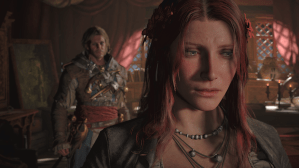
Technical issues compound these design problems. New animations and voice lines produce inconsistent results, with some additions providing excellent character insight while others—particularly Edward’s pro-Assassin one-liners during Assassin Contracts—feel like mischaracterizations that undermine his arc as a selfish rogue who gradually embraces the Brotherhood’s ideals. Brand-new cutscenes expand the story but feature poor facial animations that resemble wooden puppets. Even more troubling, some scenes that existed in the original game now display strange facial glitches, at least on Xbox Series X, that distort the subtle expressions which carried significant emotional weight in the 2013 release.
Dramatic camera shifts during assassination takedowns and chain kills, while acceptable in the sprawling environments of Egypt or Greece, create genuine frustration in Black Flag’s more confined spaces like ship decks and caves. These technical choices highlight a recurring theme: Resynced hasn’t been adapted enough to work seamlessly with its new engine, leaving players to wonder why Ubisoft didn’t simply create a new pirate adventure with a fresh protagonist rather than forcing Edward’s story into an incompatible framework.
A Solid Game That Misses Definitive Status
Despite these criticisms, Resynced remains an enjoyable experience precisely because Black Flag’s core strengths—its memorable characters, engaging naval combat, and beautiful Caribbean setting—shine through even imperfect execution. For players who never experienced the original or haven’t revisited it recently, Resynced offers an accessible entry point to one of the franchise’s finest adventures. The improvements to Anne Bonny, Blackbeard, and other supporting characters genuinely enhance the emotional impact of key story moments, and the fundamental loop of piracy, exploration, and assassination remains compelling.
The comparison to Mass Effect Legendary Edition feels apt. Both projects go beyond simple remasters to make substantive changes to their source material, but both also highlight problems that weren’t addressed or, worse, introduce new issues that didn’t exist in the originals. Resynced represents a half-step toward something truly exceptional—players will absolutely understand why Black Flag dominated the pirate gaming genre for years—but it never quite achieves the status of definitive version that fans hoped for. For those with fond memories of the original, Resynced may feel like a curious alternate universe version of a beloved classic rather than its rightful successor.
A Remake That Solves Old Problems While Creating New Ones
Resynced exemplifies the difficult tension facing modern remakes: updating beloved games for contemporary audiences while preserving what made them special. Ubisoft clearly understood some of Black Flag’s weaknesses—underused characters, dated mission types—but the solutions introduce equivalent problems elsewhere. Expanding Anne Bonny’s role demonstrates genuine narrative care, yet adding equally shallow new characters negates that progress.
The engine translation presents the remake’s most fundamental challenge. The Anvil engine built for Origins through Valhalla prioritizes RPG systems over the precise parkour that defined earlier entries. Resynced fights against its own technology, achieving competence rather than excellence in movement and combat. The removal of tailing missions acknowledges player complaints but leaves stealth improvements with nowhere meaningful to apply them.
For returning players, Resynced offers nostalgia with enough changes to feel fresh—but not enough polish to feel definitive. New players may find a perfectly serviceable pirate adventure that hints at greater heights without reaching them. The buried modern-day storyline about AI-driven historical revisionism contains genuinely compelling ideas that deserved main-story prominence rather than scavenger-hunt obscurity.
Reader Questions
Is the modern-day storyline completely removed from Black Flag Resynced?
Not entirely, but the playable Abstergo Entertainment missions are gone from the main story. The new narrative about Travelers fighting an AI called Ego exists only in hidden rifts scattered across the map that players must actively search for without map markers.
Does Resynced improve on the original Black Flag's characters?
Partially. Anne Bonny appears much earlier and Blackbeard receives expanded missions with better conclusions. However, newly introduced characters suffer from minimal screen time and unsatisfying arcs, preserving the same development issues the team fixed elsewhere.
How does combat in Resynced compare to recent Assassin's Creed games?
Resynced attempts to recreate Black Flag’s counter-heavy combat but implements pistols, rope darts, and kicks through a system resembling the RPG-era ability framework. It offers marginally more strategy than Valhalla but lacks depth for a 30-hour campaign.
Expert Opinion: Resynced exemplifies the fundamental challenge facing modern remakes: balancing nostalgia with innovation while working within engine limitations designed for different gameplay philosophies. The decision to bury the most interesting new narrative content in obscure optional side quests suggests internal uncertainty about the project’s direction. Moving forward, Ubisoft would be wise to either commit fully to reimagining classic entries or focus resources on entirely new pirate-era adventures that can be designed from the ground up for current technology.