For many fighting game enthusiasts, it’s impossible to look at Marvel Tokon: Fighting Souls without drawing immediate comparisons to the legendary Marvel Vs. Capcom series. The crossover franchise defined the tag-team fighting genre for generations, beginning with X-Men Vs. Street Fighter in 1996 and reaching its pinnacle with Ultimate Marvel Vs. Capcom 3 in 2011. For countless players who never picked up comic books as children, these games served as their primary introduction to iconic Marvel characters like the X-Men, the Avengers, and various other superheroes and villains who battled alongside Capcom’s most beloved fighters. With the Marvel Vs. Capcom series lying dormant outside of a recent compilation release, Arc System Works has stepped into the arena with its own ambitious take on the Marvel tag fighter concept, and the results are nothing short of spectacular.
A Revolutionary Four-On-Four System
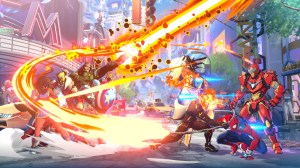
Marvel Tokon’s most radical departure from traditional tag fighters is its innovative four-on-four gameplay structure, though not for the reasons experienced players might initially expect. Conventional wisdom would suggest that each player selects four fighters with individual health bars, with victory going to whoever knocks out all opposing team members first. However, Arc System Works has fundamentally reimagined this formula. In Tokon, all four heroes share a single life bar, and matches are determined by a best-of-five rounds format. This ingenious shift transforms how players interact with their teams entirely. One player might choose to keep their strongest fighter on point while selecting assist characters that complement that fighter’s style, while another could master all four characters and incorporate complex tag strategies throughout their gameplay.
This approach brilliantly addresses one of the fighting game genre’s most persistent challenges: balancing accessibility for newcomers while maintaining depth for veterans. Arc System Works, the studio behind acclaimed titles like Guilty Gear Strive and Dragon Ball FighterZ, has leveraged over three decades of fighting game development experience to create a system that welcomes new players while rewarding mastery. The studio’s reputation for exceptional animation and fighting game mechanics is on full display here, with every aspect of Tokon’s combat system feeling meticulously crafted.
Strategic Depth Through Roster Management
Another fascinating design choice involves how players access their selected fighters during matches. Although you choose four characters before battle, you only begin with two active: your point character and one assist. The remaining two assists must be unlocked during gameplay, either by initiating wall breaks that send opponents crashing through arena boundaries and “assembling” your team in other parts of the stage, or by losing a round and gaining a hero as compensation. What initially sounds like a limitation actually serves as an elegant balancing mechanism. A player leading 2-0 might have only two characters available, while their opponent at 0-2 has access to a full roster, enabling more versatile comeback strategies. This dynamic ensures every match feels different yet equally thrilling.
The control scheme has also been streamlined without sacrificing depth. Special moves follow a “button press plus directional input” approach similar to Super Smash Bros., making the game immediately accessible to newcomers. Advanced inputs remain available for dedicated players seeking to optimize their performance. Assists function similarly, with a simple L2 hold allowing instant character switches to continue combos. The philosophy of “easy to learn, hard to master” permeates every aspect of Tokon’s design, and the execution is remarkably successful.
A Carefully Curated Character Roster
The initial roster features 20 characters, which is modest by tag fighter standards—Marvel vs. Capcom 3 launched with 36 playable fighters. However, this smaller roster contributes to the game’s balanced approach, giving newcomers a manageable pool of matchups to learn while veterans can quickly identify their preferred characters. The selection blends expected fan favorites with intriguing deep cuts from Marvel’s extensive character library. Captain America, Iron Man, Hulk, Magneto, and Doctor Doom all make appearances, while Carnage, Star-Lord, Blade, and Loki make their Marvel fighting game debuts. Perhaps the most obscure inclusion is Danger, the sentient form of the X-Men’s training facility—proving that Marvel fighters continue their tradition of introducing players to lesser-known characters.
Deadpool deserves special recognition for how Arc System Works has incorporated his fourth-wall-breaking nature. The character serves as a tribute to fighting game history itself, with references ranging from obvious nods to Mortal Kombat’s Scorpion to obscure callbacks to forgotten titles like Kaiser Knuckle. Personal standouts include Peni Parker, whose arena-filling drone tactics create excellent offensive opportunities, and Ms. Marvel, whose stretchy limbs create constant pressure across the screen. The Shuri version of Black Panther offers exciting gameplay options, while Green Goblin’s glider-based approach presents an intriguing puzzle for players to solve.
Comprehensive Game Modes And Online Play
Tokon offers substantial content for both single-player enthusiasts and online competitors. The Episodes mode tells five different stories across the game’s featured teams, each animated by a different artist and completable in roughly an hour. The All-Star Arena mode splits into Arena and Survival sections, with Arena providing traditional arcade-style progression and Survival offering gauntlets of up to 100 battles against increasingly powerful opponents. The Arcadia Rumble mode introduces arena-style challenges where players collect items for points and power-ups, offering a party-game alternative to standard matches.
Online features include ranked matches, casual matches, custom private lobbies, and an innovative Open Lobby system where players explore chibi-style environments with customizable avatars, challenging others at scattered arcade machines. The rollback netcode ensures smooth connections, with minimal technical issues on PlayStation 5. However, the PC version’s launch has been problematic, plagued by connection issues, choppy performance, and various technical problems. While patches are addressing these concerns, PC players currently face a significantly diminished experience compared to console users. Once these issues are fully resolved, the PC version should match the excellent console experience.
Marvel Tokon: Fighting Souls represents a triumphant homecoming for Marvel’s fighting game presence. Rather than simply replicating past successes, Arc System Works has put its own distinctive spin on the tag fighter formula, establishing a new benchmark for the genre. With its innovative four-on-four system, accessible yet deep gameplay mechanics, and stellar presentation, Tokon positions itself as a foundational title for modern fighting games with tremendous potential for the future.
Expert Opinion: Marvel Tokon: Fighting Souls demonstrates that Arc System Works has become the premier developer for licensed fighting games, following their success with Dragon Ball FighterZ. The innovative shared health bar and round-based structure could influence tag fighter design for years to come. Assuming Arc System Works maintains strong post-launch support and resolves PC technical issues promptly, expect Tokon to establish a significant presence in competitive fighting game circuits throughout 2025 and beyond.