
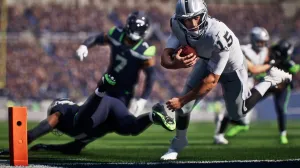
For decades, sports video games have operated under a persistent cloud of skepticism, with critics and players alike leveling the familiar complaint: “same game, different year.” While never entirely accurate, this sentiment has resonated with millions of gamers who purchase annualized sports simulations expecting meaningful improvements, only to feel disappointed by incremental changes. Among all sports franchises, EA’s NFL simulation Madden has perhaps been the most frequent target of this criticism. However, after five consecutive years of genuine improvement, it’s time to acknowledge an uncomfortable truth for longtime skeptics: Madden is genuinely good again.
The journey to this point hasn’t been smooth. There have been numerous years when Madden fumbled the opportunity to properly represent America’s most popular sport, leaving fans frustrated every August when the new installment dropped. But beginning with Madden 23, the development team at EA Tiburon has been methodically building and iterating on foundational gameplay mechanics in ways that are both clear and beneficial. This culminates with Madden NFL 27, which delivers what may be the most satisfying on-field experience in over a decade. The virtual gridiron has never felt better, and the improvements are substantial enough that the old memes and criticisms simply no longer apply with the same force they once did.
Defense Takes Center Stage
The defensive side of the ball represents the most significant advancement in Madden 27. Last year’s installment, despite receiving high praise at launch, suffered from a catastrophic bug that emerged a month or two after release, essentially breaking the pass rush for the remainder of the game’s lifecycle. This resulted in absurdly high-scoring affairs, with games routinely exceeding 90 total points. In competitive Madden leagues, some players were posting 70+ point performances multiple times per season. Defense was essentially non-functional at the highest levels of play.
Madden 27 serves as the remedy to these ailments. This year’s game places intense focus on giving players more control over their defenders while dramatically improving zone coverage and pass rushing mechanics. In previous iterations, playing defense felt like it required almost supernatural anticipation to make stops. Now, with smarter zone coverage, players can actually rely on AI-controlled defenders to do their jobs. Defenders no longer stand stationary in the middle of their zones like confused spectators. Instead, they actively “look for work,” diagnosing play progression and responding proactively rather than reactively. This represents a fundamental shift in how defensive football plays out in the simulation.
Revolutionary Control Scheme Overhaul
The new control scheme introduces shoulder-button commands that allow players to adopt conservative, aggressive, or ultra-aggressive defensive postures before the snap. These new tools are part of a complete remapping of pre-play adjustments that, while requiring some adjustment for longtime players who have developed years of muscle memory, ultimately proves worth the learning curve. Actions that previously required four or five button presses now take just two, dramatically speeding up the pre-snap chess match that defines high-level Madden competition.
Perhaps the most revolutionary addition is the macro adjustment system, which allows players to bundle multiple individual changes into single commands. For instance, if a player anticipates a specific offensive play, they can instantly activate a macro that simultaneously adjusts defensive line spacing, cornerback shading, and linebacker zone depth—all with just two button presses. These macro adjustments and the streamlined controller remapping represent changes clearly designed for the hardcore competitive community, signaling EA’s renewed commitment to serving dedicated players first and foremost. Even casual players who find macros too complex can utilize default presets without ever diving into menu customization.
Timing-Based Catching Changes Offensive Dynamics
While defensive improvements steal the spotlight, offense receives meaningful attention as well. Timing-based catching, introduced to both of EA’s American football games this summer, asks players to press the catch button at the precise moment the ball reaches their receiver’s hands, similar to timing a shot release in NBA 2K. Madden benefits from lessons learned during College Football’s launch-week struggles with the same mechanic, resulting in a more polished implementation. This optional feature, which can be toggled off, adds another layer of player input to passing plays, reducing what competitive players call “Madden Math”—the behind-the-scenes attribute calculations that determine contested catch outcomes.
The mechanic requires some adjustment, and concerns exist about whether EA can find the perfect balance point as player feedback rolls in over the coming months. If the studio can settle the feature into something predictable and reliable, it could become a cornerstone mechanic that evolves positively for years. If community reception remains mixed, it may follow the path of QB Vision—a feature quickly swept out of the game after failing to find its footing. For now, the mechanic adds welcome depth to the passing game.
Franchise Mode Finally Delivers Meaningful Changes
For many dedicated Madden players, Franchise mode represents the primary destination, and for the second consecutive year, it delivers substantial changes worth celebrating. The marquee addition is the Persona Engine, which assigns every player multiple personality traits and transforms roster management into an interpersonal minigame. Players might prioritize team success over personal gain, or they might be driven primarily by financial considerations. Some veterans approaching career’s end might demand a chance to compete for a championship, while others might request trades if they feel disrespected during contract negotiations.
Similar systems existed in previous Maddens, but they were largely confined to free agency periods and held minimal actual influence on gameplay decisions. This year, the Persona Engine genuinely reshapes rosters in unpredictable ways. Managing a 53-man roster finally feels like coaching 53 distinct individuals with their own motivations and priorities. Contract negotiations have also been completely overhauled to better reflect real NFL practices. Players can now negotiate void years, adjust the balance between salary and bonus money, apply no-trade clauses, and utilize other options that dynamically appear during negotiations. These discussions now occur throughout the season rather than being clustered into artificial windows.
Monetization Remains a Persistent Problem
Despite the genuine improvements to core gameplay and Franchise mode, Madden 27’s monetization practices continue to frustrate. The Superstar career mode, while offering some enjoyable moments, remains plagued by technical issues and aggressive monetization. The play-by-play scoring system frequently malfunctions, recording tackles as assists, penalizing players for blocks they successfully executed, and even displaying incorrect win-loss records. Beyond these technical problems, Superstar drowns players in menus, awkward brand integrations, and dialogue choices that ultimately make little difference to outcomes.
Players can purchase levels to accelerate avatar improvement, and they can additionally buy a Superstar Pass—essentially a battle pass system offering extra skill points for leveling up. Progression without spending money is deliberately slow and frustrating. Ultimate Team, meanwhile, continues its decades-long reign as the poster child for pay-to-win mechanics in a full-priced game. While the mode receives minimal new content this year, what exists remains a time-consuming grind dominated by players who spend hundreds or thousands of dollars to gain competitive advantages. The mode-agnostic Team Pass costs an additional $10 every few weeks and includes recycled content from previous installments—particularly frustrating when it means outdated team branding appears in cosmetics.
Presentation Reaches New Heights
On a more positive note, Madden 27’s presentation package has never looked better. Holiday-themed broadcast elements for Halloween, Thanksgiving, and Christmas add seasonal flavor to the experience. Alternate field designs now deploy automatically alongside throwback and alternate uniforms, creating cohesive visual experiences. Weekly recap and halftime shows have been expanded with new segments, all hosted by Scott Hanson, whose authentic delivery brings genuine electricity to each broadcast element. These presentation improvements, while perhaps less dramatic than gameplay changes, contribute significantly to the overall experience.
Madden NFL 27 represents the fifth consecutive year in which on-field gameplay has been fundamentally sound while improving on its predecessor. This is a heartening trajectory for a franchise that has weathered both celebrated eras and difficult periods throughout its long history. Despite persistent problems with Superstar mode monetization and Ultimate Team’s pay-to-win structure, Madden has recaptured something essential. The outdated criticisms no longer apply to a game that has evolved substantially over the past half-decade. For players willing to focus on Franchise mode and embrace the many new tools available on the virtual field, Madden 27 offers an experience worth celebrating—a genuine return to form for gaming’s most scrutinized sports franchise.
Expert Opinion: The transformation of Madden over the past five years represents one of the most significant turnarounds in sports gaming history. EA Tiburon’s decision to prioritize competitive players and fundamental gameplay mechanics over flashy but shallow features has paid dividends, creating a foundation that can support meaningful annual improvements rather than cosmetic iterations. If the studio can address the persistent monetization concerns before launching its rumored social hub mode, Madden could cement itself as the gold standard for sports simulations rather than simply being a competent annual release.