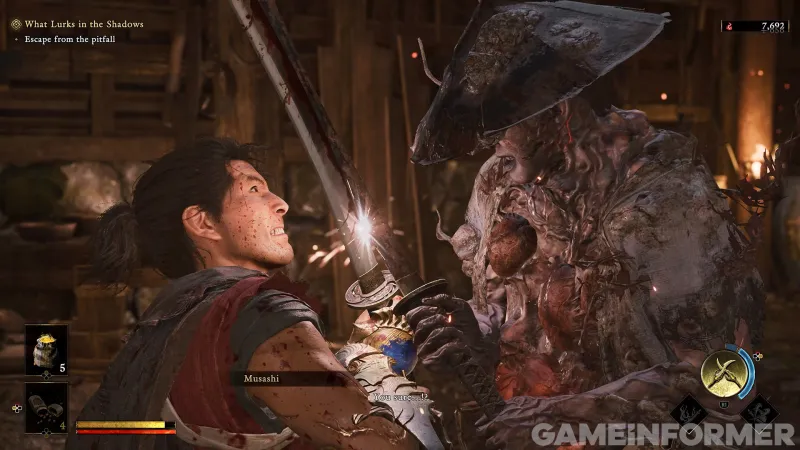
After two decades of silence, Capcom’s beloved samurai action franchise Onimusha is making a dramatic return with Way of the Sword, and the Japanese gaming giant has pulled out all the stops to ensure the combat system honors the series’ legacy while pushing it firmly into the modern era. The game recently graced the cover of Game Informer, prompting an extensive behind-the-scenes look at how director Satoru Nihei and animation team lead Hiroshi Yugen approached the monumental task of reviving a franchise that last saw a mainline release in 2006. Their ambitious goal was nothing short of transformative: take the cinematic, larger-than-life action sequences from previous Onimusha cutscenes and make them the actual gameplay experience players would have with every sword swing and parry.
From Cutscenes to Gameplay: The Vision Behind Way of the Sword
When Nihei approached Yugen to join the project, the veteran animator immediately dove into research by revisiting the classic Onimusha titles. What struck him most was the disconnect between the spectacular action shown in cutscenes and the actual gameplay, which, while revolutionary for its time, couldn’t capture the same cinematic intensity due to technological limitations. Yugen made it his mission to bridge this gap, ensuring that every combat encounter in Way of the Sword would feel as epic as those pre-rendered sequences that captivated players on the PlayStation 2. This required extensive research into authentic samurai swordplay, including studying Edo-period fighting techniques, understanding the fundamentals of historical sword duels, and consulting with professional sword fight choreographers who could explain the reasoning behind specific stances, swings, and defensive maneuvers.
The development team’s commitment to authenticity extended to studying the work of legendary Japanese actor Toshirō Mifune, whose likeness serves as the face of protagonist Miyamoto Musashi. Mifune, widely regarded as one of the greatest actors in cinema history, starred in numerous Akira Kurosawa samurai films including Seven Samurai and Yojimbo, as well as the 1950s Samurai Trilogy where he portrayed the historical swordsman Musashi. However, Yugen emphasized that inspiration came from across the entire samurai film genre, not just Mifune’s work. The team studied not only action sequences but also the human elements—defeated samurai retreating from battle, moments of quiet contemplation, and the emotional weight that these warriors carried. This holistic approach to understanding the samurai archetype informed everything from Musashi’s movement patterns to his idle animations.
Reinventing the Iconic Issen System
One of the most significant updates in Way of the Sword involves the Issen, a signature move from the original Onimusha games that allows players to instantly kill smaller enemies or deal massive damage to larger foes by attacking at the precise moment an enemy strikes. In previous titles, the Issen was satisfying but executed so quickly that players often couldn’t fully appreciate what was happening on screen. Nihei challenged Yugen to reimagine the Issen as something more realistic and grounded—a move that players could actually see and feel in a meaningful way. The result is approximately ten different Issen variations that Musashi can execute depending on the angle of incoming attacks, the type of enemy, and other contextual factors. This expansion transforms what was once a single impressive technique into a diverse vocabulary of lethal counter-attacks that rewards player skill and attention.
Perhaps even more technically challenging was implementing Musashi’s new blocking system. Rather than settling for a simple animation that pivots the character in place regardless of attack direction, Nihei insisted on a comprehensive system where Musashi blocks realistically from dozens of angles. This meant creating distinct animations for high attacks from behind, mid-level strikes from the left, low sweeps from various directions, and countless other combinations. Yugen admits the process was incredibly time-consuming and difficult, but seeing the system in action and observing player reactions has validated the enormous effort. This attention to detail extends throughout the combat system, creating a swordplay experience that feels both authentic and viscerally satisfying.
Balancing Legacy and Evolution
The twenty-year gap between mainline Onimusha releases presented unique challenges for the development team. The action game landscape has evolved dramatically since 2006, with titles like Dark Souls, Sekiro: Shadows Die Twice, and Devil May Cry 5 raising player expectations for combat depth and responsiveness. Yugen acknowledged the importance of studying these developments while maintaining the distinct identity that made Onimusha special. Classic mechanics like the Issen and Chain Issen return alongside new additions such as the Blade Barrage, creating a combat system that should feel familiar to series veterans while offering fresh experiences for newcomers.
One notable innovation is the inclusion of two distinct control schemes: Aggressive and Defensive. The Aggressive layout places primary attacks on face buttons with blocking assigned to Square, catering to players confident in their offensive capabilities and familiar with traditional action games. The Defensive scheme moves blocking to L1 and makes defensive maneuvers like parrying more accessible for players who prefer a more cautious approach. Nihei, who has previously worked on titles across Capcom’s diverse portfolio, explained that the team debated extensively about which control scheme to implement before ultimately deciding both approaches deserved inclusion. This flexibility demonstrates Capcom’s commitment to accessibility without compromising depth—a balance that modern action games increasingly strive to achieve.
A New Era for Samurai Action
Players curious about these combat innovations can experience them firsthand through the Way of the Sword demo, currently available on PlayStation 5, Xbox Series X/S, and PC. The demo allows players to experiment with both control types and get a feel for the refined Issen system before the full game launches. While Way of the Sword will also release on Nintendo Switch 2, a demo for Nintendo’s new platform is not yet available. The game’s setting in Kyoto, Japan’s ancient imperial capital, provides a rich backdrop for samurai action, with the city’s historical temples, gardens, and urban landscapes offering diverse combat environments.
Yugen’s thirty-year tenure at Capcom has seen him work on numerous acclaimed titles, yet this marks his first involvement with the Onimusha series—an opportunity he accepted immediately when Nihei approached him. His status as what Nihei calls “a legend within Capcom” speaks to the studio’s commitment to assembling the best possible team for this long-awaited revival. The combination of veteran expertise with fresh perspectives on the franchise appears to be paying dividends, with early hands-on impressions suggesting that Way of the Sword successfully captures the spirit of classic Onimusha while delivering combat that meets contemporary standards. As Capcom stated in promotional materials, their goal is nothing less than creating “the pinnacle of swordplay action games”—an ambitious target that, based on early evidence, they may well achieve.
Expert Opinion: Capcom’s methodical approach to reviving Onimusha—combining authentic historical research with modern game design sensibilities—represents the ideal template for franchise revivals in the gaming industry. The dual control scheme innovation particularly stands out as a solution that respects both hardcore action fans and newcomers, potentially expanding the game’s audience significantly. If the full release maintains the quality evident in the demo, Way of the Sword could establish a new benchmark for samurai action games and prove that dormant franchises can return stronger than ever with the right creative vision.